

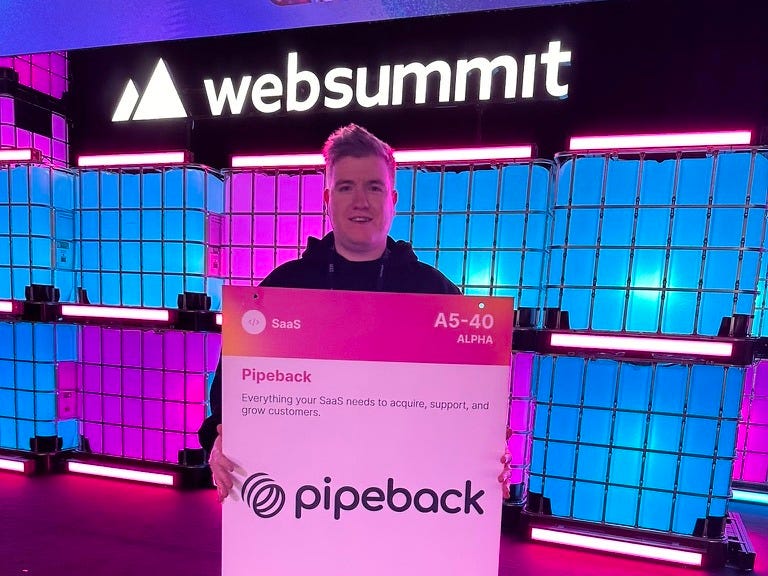
I returned from Lisbon a few days ago and I’m still processing everything that happened at Web Summit 2025. You know that feeling that you just accelerated your company’s growth by years, all in just 4 days? That’s exactly how I’m feeling.
Many people asked me before I went: “Paulo, is it really worth spending tens of thousands of reais to exhibit at a fair like that? Wouldn’t it be better to invest that money in ads or product development?”
Let me tell you in detail why this was one of the best decisions I made for Pipeback this year.
In-person sales in a digital world
First, let’s talk about the obvious, which isn’t always so obvious: we made deals at the event.
And look, the deals happened in every possible way. Some companies wanted to close deals right there after seeing the product live. Most preferred to schedule more detailed demos after the event – we left with a full schedule for the next few weeks. And then there were those happy hour conversations where you know they’ll turn into clients, it’s just a matter of time.
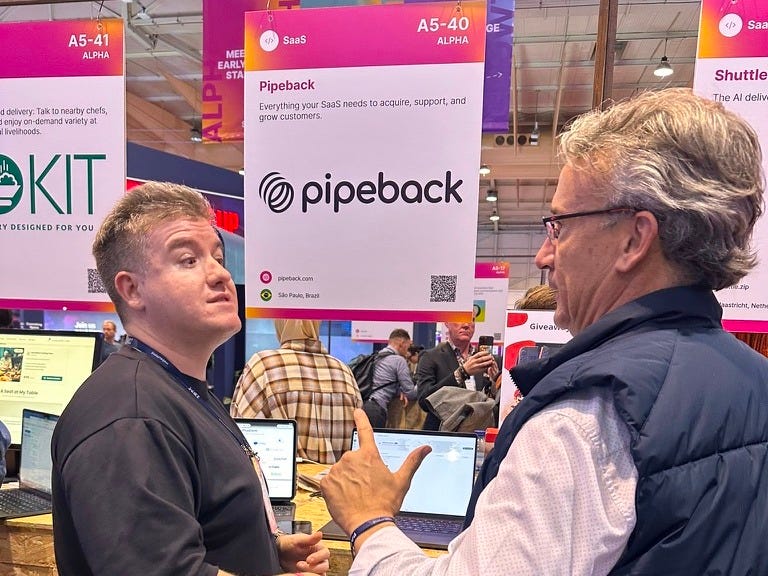
That’s what many people don’t understand about in-person events: the booth is crucial – we qualified hundreds of leads there, demonstrated the product dozens of times, scheduled meetings. But the real power lies in the combination of everything: booth + happy hours + dinners + hallway encounters.
There’s something magical about in-person events that digital can’t replicate. People see you demonstrating the product live, ask questions on the spot, but they also meet you at the coffee break, continue the conversation at the evening event, and advance the deal at lunch the next day.
In-person and digital complement each other perfectly. The leads we capture will enter our automated workflows, but with a crucial difference: they’ve already seen the product in action, and have already established a connection with our team.
The pipeline we built in these 4 days will fuel our next few quarters. And that’s without even mentioning the long-term relationships that will bear fruit for years to come.
Strategic partnerships that change everything.
But direct sales were just the tip of the iceberg. What will truly impact our growth in the coming years are the strategic partnerships we’ve identified.
We spoke with dozens of potential partners from different segments – integrators, consultancies, other startups. And the most valuable thing was discovering which distribution channel could be a game changer for Pipeback. I won’t reveal which one it is yet, but I can say that we are already structuring the entire operation to open this channel in the coming months.
It was the kind of discovery you only make in person, talking to different players, understanding how they operate, where the opportunities are. That insight alone was worth the trip.
In addition, we closed important technological partnerships. Partners in telephony, infrastructure, integrations that will greatly elevate the level of Pipeback’s product.
Global Validation: Our thesis was correct.
I personally spoke with over 100 SaaS founders and executives during the event. And you know what became crystal clear? Our thesis of creating an all-in-one software solution for SaaS, integrating support, sales, and marketing, is not just a necessity – it’s a market urgency.
Founder after founder told me the same story: “We’re using 15 different tools, spending a fortune, and yet things don’t communicate with each other.”
Our ICP (Ideal Customer Profile) became even clearer: SaaS companies with between 10 and 50 employees, which have already passed product-market fit but still lack the structure to develop internal tools. It’s a gigantic and extremely underserved market.
Announcing Partnership with Globalfy.com
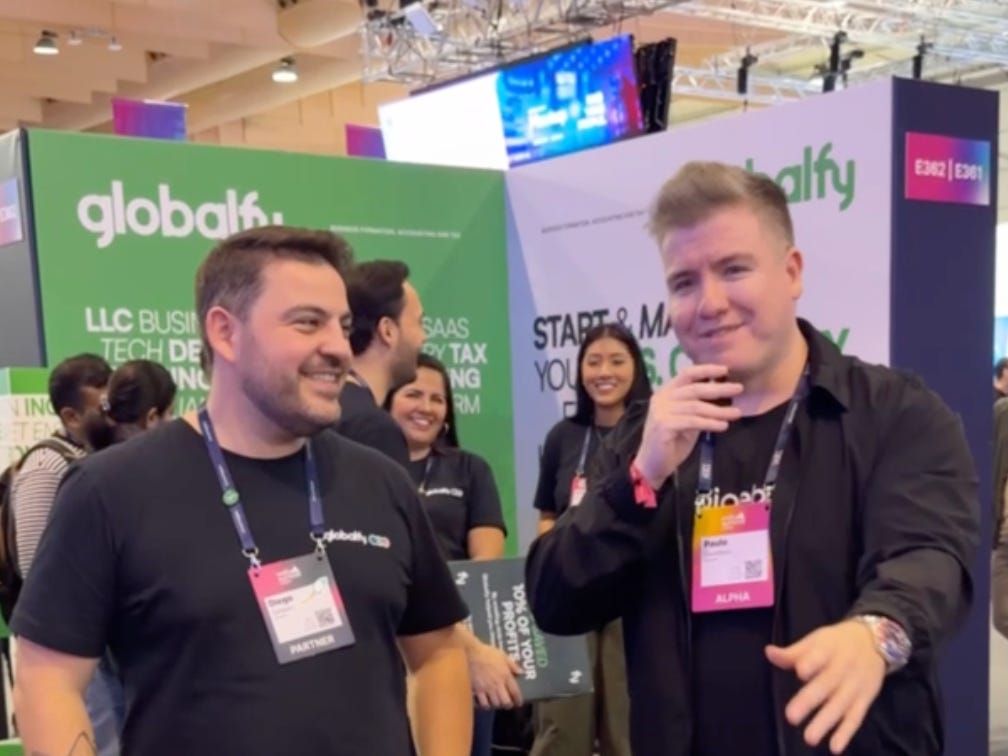
One of the most special moments was taking advantage of the Web Summit to officially announce my partnership as an ambassador for Globalfy. We recorded a video directly from Lisbon and posted it on social media – the timing couldn’t have been better.
To give some context: Globalfy helps Brazilian entrepreneurs open companies in the United States, taking care of all the bureaucratic and accounting aspects. It’s something I’ve always informally recommended, but now the partnership is official.
Why does this matter? Because a large part of the Brazilian founders who follow me on Instagram, who participate in Indies.club (my community), and even those I met at the event, all have the same goal: to expand globally. And the first barrier is always the legal structure.
Now I can help them not only with Pipeback, but also with this fundamental part of international growth. It’s a partnership that makes perfect sense for my audience.
It’s the kind of partnership where everyone wins: I add value to my audience, Globalfy gains qualified clients, and Brazilian entrepreneurs have a clearer path to scale globally.
The Investor Who Crossed the Atlantic
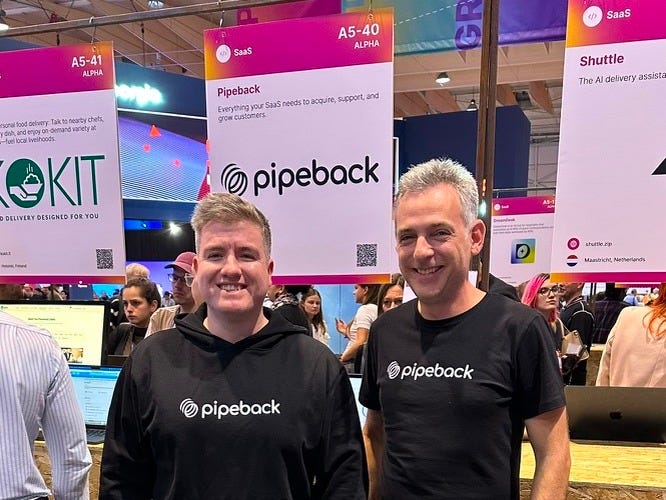
My main investor flew from the United States to attend Web Summit. And look, that was crucial – not only for the day he spent with me at the booth helping with presentations, but mainly for the four days we spent together in Lisbon.
We shared the same hotel, had breakfast together every day, and discussed strategies late into the night. It was a total immersion in the Pipeback universe. He saw firsthand people’s reactions to the product, heard the feedback, and witnessed the genuine market interest.
Most importantly, it became crystal clear to him that our all-in-one product thesis isn’t just an idea – it’s a real market need. He saw with his own eyes dozens of companies asking for exactly what we’re building.
This deeper connection, this quality time together, is worth more than a thousand Zoom calls. Now he not only invests in Pipeback – he lived Pipeback during those days. He understood our pain points, our opportunities, our potential in a way that reports and metrics could never convey.
Network with the portfolio
Another incredible benefit was meeting in person with other companies in my investor’s portfolio. The Tintim.app team had a booth near ours, and the exchanges were fantastic.
We shared metrics, growth strategies, mistakes we made, what worked, what didn’t. It’s a type of knowledge you don’t find in any course or book – insights from those in the trenches, facing the same challenges.
The Nintendo Switch 2 Giveaway
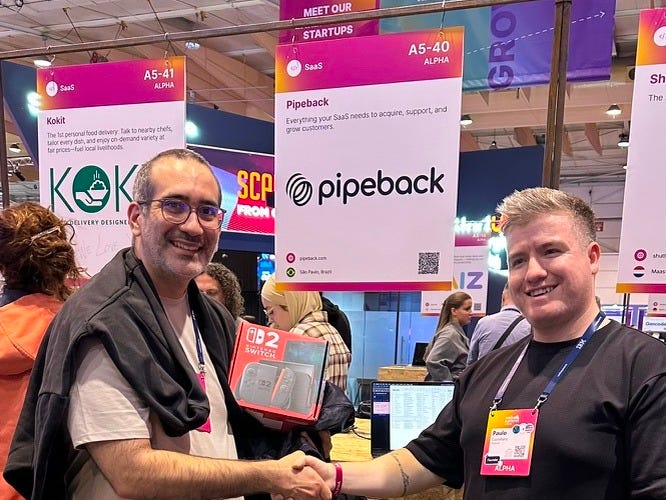
Now, let me tell you about the most insane moment of Web Summit: the Nintendo Switch 2 giveaway.
The idea was simple: people scanned a QR code and filled in their information. Based on the questions in the form, we were already doing an initial qualification of the leads.
What we didn’t expect was the scale it would reach.
At the scheduled time for the draw, our booth was PACKED. There were over 100 people there, all waiting for the result. It was surreal.
But the most brilliant thing was what happened: while waiting for the draw, people started asking about Pipeback. Several scheduled demos for the following week. There was even a private equity fund from Lisbon that has exactly the problem Pipeback solves – they left super interested.
Final result: we captured hundreds of qualified leads. The CPL (Cost Per Lead) was a fraction of what we pay for online ads, and the quality is incomparable – these are people who had real contact with our product and team. The Nintendo Switch was an investment that paid for itself many times over.
Demos and Follow-ups
We left Lisbon with a completely full schedule for the next few weeks. These are companies from various countries, ranging from early-stage startups to scale-ups with hundreds of employees.
Most importantly: we’ve learned to be selective. There’s no point in scheduling demos with everyone who walks through the booth. We focus only on companies that truly fit our ideal profile – SaaS companies that already have traction but still struggle with the mess of using a thousand different tools.
This more rigorous qualification means fewer demos, but of much higher quality. These are conversations that have real potential to turn into business, not just “let’s see what you do.” Each company we schedule has a specific pain point that we know how to solve.
It’s the difference between quantity and quality.
European Expansion 🇪🇺
Perhaps the most important discovery of the event: we urgently need a data center in the European Union.
We spoke with at least 20 large European companies that loved our solution, but can’t use a product with data hosted only in the US. GDPR is no joke there.
This is the kind of feedback that changes the roadmap. We are already accelerating our infrastructure expansion plans. By the end of this year, we will have a presence in Europe. This single insight could mean millions in additional revenue.
Lessons learned and improvements for 2026
Of course, not everything was perfect. We made mistakes that we won’t repeat:
Our giveaway could have been MUCH bigger. We collected hundreds of leads, but we could easily have reached thousands if we had been more aggressive in our promotion. We raffled off the most anticipated video game of the year, and even then we were timid. Next year, the strategy will be completely different – we will dominate the event with our activation.
We need a bigger booth. The space we had couldn’t handle the volume of interest. There were times when there were lines of people waiting to talk to us. It’s a good problem, but still a problem.
We should have organized our own parallel events. I saw competitors doing exclusive happy hours, private meetups, VIP dinners. They captured the attention of the best leads outside of the official event hours. This is a missed opportunity that we won’t repeat.
But these are good problems to have. They mean that demand was higher than expected and that we have a lot of room to grow.
We're back in 2026 🇵🇹
It’s already decided: we’ll be there again next year.
Web Summit 2025 wasn’t an expense – it was an investment that’s already paying dividends. Between closed sales, generated pipeline, strategic partnerships, and market insights, the ROI is impossible to fully calculate, but it was certainly worth every penny.
And the best part: now we know exactly what to do to extract even more value from the event. 2026 will be the year Pipeback dominates Lisbon.
For those of you thinking about exhibiting
If you have a SaaS company, sell globally, and are considering exhibiting at Web Summit or similar events, my advice is straightforward: do it, but do it right.
Don’t just go to “mark your presence.” Have clear objectives:
How many leads do you want to capture?
How many demos do you want to schedule?
What kind of partners are you looking for?
What market validation do you need?
Prepare to work harder than ever during the event. These are 12-14 hour days on your feet, talking, selling, networking. It’s exhausting, but it’s the kind of exhaustion that accelerates years of growth in just a few days.
Pipeback entered Web Summit 2025 as a promising startup. We left as a globally validated player, with strategic partners, a robust pipeline, and a crystal-clear vision of how to dominate our market.
And that, my friends, is priceless. Or rather, it has a price – and it’s worth every penny invested.
If you were at Web Summit and we didn’t connect, reach out to me on LinkedIn or Instagram. I’m still processing hundreds of contacts we made and would love to continue the conversations that started in Lisbon.
For Brazilians who want to expand globally and open a company in the US, contact me and I’ll connect you with Globalfy. As an ambassador, I can get an exclusive discount for my followers.